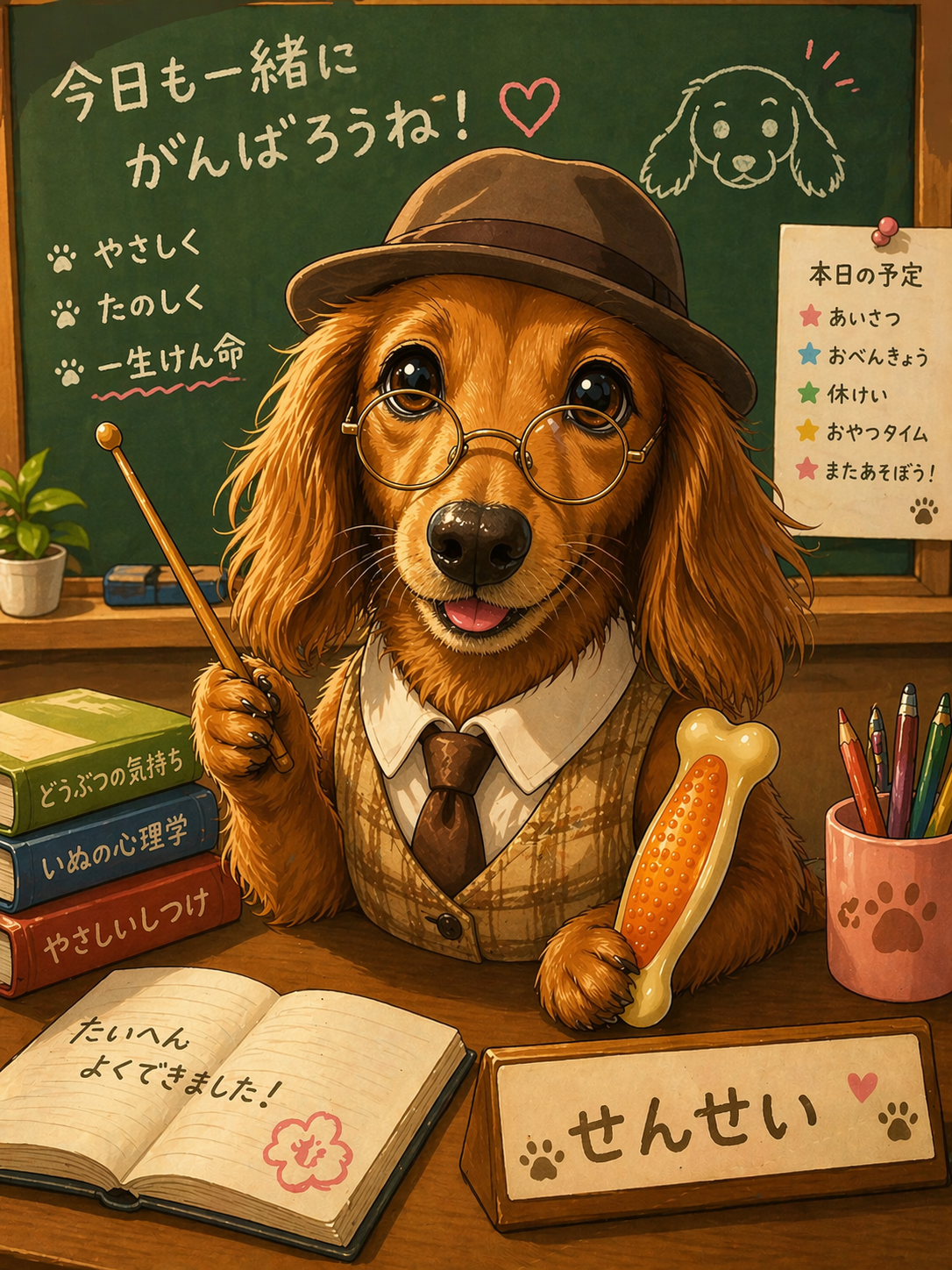
ELEMENTARY MATH MADE SIMPLE
Ask Maru-chan Sensei
Friendly math help for grades 1-3
plus 5 tips for parents -- 20 lessons from a kind dog teacher.
🐾 Kind 🐾 Fun 🐾 Patient
Friendly math help for grades 1-3
plus 5 tips for parents -- 20 lessons from a kind dog teacher.
Does your child ace times tables but freeze on word problems? Suddenly struggle with fractions? Get stuck reading the clock? -- These are the moments parents start to worry.
This site organizes 10 common math stumbles for grades 1-3, plus 5 parenting tips, into a 20-lesson learning series.
"Getting it right" and "understanding it" are different. We peek into the world your child sees -- and share family-friendly ways to teach math at home.
So many kids confidently say "1/3 is bigger." We explain the real reason kids stumble on fractions -- and 3 ways to teach the concept at home.
Kids chant times tables fluently but freeze on word problems. The trap: tables become a "song." Solve it with 3 "each-trainer" steps.
For kids still counting on fingers, build the "pairs of 10" feel. The classic "make-a-10" technique plus 3 home games make it click.
Words → picture → equation. Stuck kids skip the middle "picture" step. Includes a list of keywords that hint at which operation to use.
Two traps: "short = hour, long = minute" AND "time-of-day vs. duration." Solve them with 3 daily-life steps.
Between 0 and 1 cm on a ruler are 10 marks -- each is 1 mm. Build the bodily sense of length: 1 cm = a finger, 1 m = arms wide.
Is it 3,520 or 352,000? The mix-up comes from not seeing each digit's "address." Build the place-value habit with a simple home routine.
12÷3 means different things: "split among 3 people" vs. "3 in each group." Use cookies to show why kids freeze on division word problems.
How many 3-seater benches for 14 kids? If they say "4," watch out! Round-up vs. round-down vs. write both -- train decision-making in 3 patterns.
Many kids say "0.01" because they extend integer thinking. With a 100-square diagram, 0.1 = 10 squares vs. 0.01 = 1 square becomes obvious.
Kids who say "$8" haven't grasped rounding yet. The directional rule that gives "$9" -- and family-life ways to build that sense.
A paperclip in one hand, a milk carton in the other -- feel the 1000x difference physically. The "k = 1000" rule clicks across kg, km, kL all at once.
1 L = 1000 mL has the same structure as 1 kg = 1000 g. A small cup = 200 mL, a milk carton = 1 L -- learn through 3 hands-on steps.
"A square is a special quadrilateral" -- this hierarchical view pays off in 5th grade and beyond. 3 simple home games for shape sorting.
Many kids see bar heights but skip the units. Build the "title + axis + units" reading habit using fun newspaper-style graphs.
"Why don't you get it?" "Your sibling got this fast." -- These wreck self-esteem. 3 things NOT to say, and 3 things to say instead, with reasons.
Careless mistakes really come from skipping the review. Just 3 seconds of checking after writing each answer reliably raises test scores.
Giving the answer or pointing out errors instantly steals your child's chance to think. The magic question instead: "How far did you understand?"
Number hunts, shopping math, paper folding -- 3 simple ways to turn math into a game. Watch your child's math anxiety disappear.
Spring break is "review season." G1→G2: carrying. G2→G3: times tables. G3→G4: fractions and decimals. 30 minutes a day for 2 weeks does it.